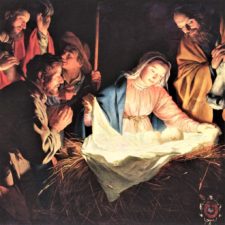
(Don & Joy Veinot – Midwest Christian Outreach) We are a week away from the annual celebration of the incarnation, and the Christmas season is in full swing on all fronts. The Christmas story of the birth of Jesus is very often recounted by churches in pageant form, with children “acting” as various biblical characters. Our home church put on just such a pageant last Sunday. It was simply adorable, as are most Christmas Pageants featuring children as Angels, Shepherds, Mary and Joseph, and the babe in the manger…not to forget the two sheep and a donkey, also played by children who hee-hawed and Baaed at the appointed time. And of course, we must mention the star of Bethlehem, happily bopping about on the stage – with what looked like legs and even a face. Whether or not the “star” also had hands, our somewhat ancient memories cannot supply that information at the moment, but we certainly cannot deny that possibility either.
Our church also staged a live nativity scene in our small town’s center. Two live sheep were there in a “pen” next to the “stable.” There did not appear to be a little star or a donkey in the vicinity, or at least these did not show up in the pictures of the event.
There is, of course, the typical wrangling going on in culture as to the meaning of the day and the holiday. Secularists are working hard, and somewhat effectively, to divorce Christmas from anything to do with God. The idea that a supreme deity even exists is too much for them to believe. It stretches their credulity even more to think that such a being would send His own Beloved Son down to take on human flesh and redeem humanity through His own perfect life and His terrible sacrificial death.
Many in cults, like Jehovah’s Witnesses, and yes, some Christians, hold that Christmas is a pagan celebration having little or nothing to do with the incarnation of our Savior. The Biblical Archeology Society, “How December 25 Became Christmas,” on their Bible History Daily, weighs in on the question. They do a balanced job and also note that the information from the first and second centuries on the topic is sparse:
There is no mention of birth celebrations in the writings of early Christian writers such as Irenaeus (c. 130—200) or Tertullian (c. 160—225). Origen of Alexandria (c. 165—264) goes so far as to mock Roman celebrations of birth anniversaries, dismissing them as “pagan” practices – a strong indication that Jesus’ birth was not marked with similar festivities at that place and time. As far as we can tell, Christmas was not celebrated at all at this point.