Let the Little Ones Come to Me — Social Justice Gone Awry

Dr. Peter Jones of Truth X-Change weighs in on what liberals refer to as “Social Justice Christianity.” One example Dr. Jones offers is World Vision’s gradual move away from sharing the true Gospel of Jesus Christ with the lost as they instead encourage people to embrace a works-based social justice gospel. Jones writes:

The evangelical church is increasingly aware of the need to witness to Christ in acts of mercy, especially since some evangelicals in the past spoke almost exclusively of individualistic and future salvation. In reaction, some today are adopting “orthopraxy” (right action) as their main emphasis, downplaying or even abandoning “orthodoxy” (right belief). But good works and sound belief cannot be separated. Alas, instead of a biblical balance, we face the serious danger of a new form of the old “social gospel,” which turns the Christian faith into a system of salvation by works, Jesus into a mere example, like the Buddha, Socrates or Lao Tzu, and Christianity into one variant of interfaith good will. But orthopraxy alone cannot preach the gospel. We as redeemed sinners must “confess with our mouth that Jesus is Lord.”

View article →

What’s Missing from this Picture?—Fertility on the Rise, Worldview on Display

Dr. Albert Mohler writes:

USA Today reported last week that the United States “is taking baby steps forward” in terms of the fertility rate. According to the forecasting group Demographic Intelligence, the USA’s total fertility rate is likely to increase to 1.90 per woman in 2013, up slightly from 1.89 in 2012. Last year’s figure was the lowest recorded in 25 years.

“The United States has seen marked declines in childbearing in the wake of the Great Recession, but we think that this fertility decline is now over,” Sam Sturgeon, president of Demographic Intelligence, told USA Today. “As the economy rebounds and women have the children they postponed immediately after the Great Recession, we are seeing an uptick in U.S. fertility.”

Sturgeon, like many others, points to economic factors as the main driver of fertility rate fluctuations. Similarly, Mark Mather of the Population Reference Bureau said: “Historically, we’ve seen fertility trends move up and down with economic indicators.”

But, wait just a minute.

View article →

David Barton Says Four Professors Criticized The Jefferson Lies; He Forgot Some

David Barton critic, Professor Warren Throckmorton, challenges the Christian historian’s claim that only four professors criticized Barton’s book, The Jefferson Lies. Throckmorton begins by saying:

Facts are pesky.

On July 19, Steve Deace interviewed David Barton (at 24:12 in hour 3) in Iowa after the big political confab there with Ted Cruz and Rand Paul. Deace asked Barton to describe the controversy over The Jefferson Lies (now approaching a year ago). He also asked if there was any substance to the criticism.

Barton said a bunch of stuff he usually says about it (e.g., publisher Thomas Nelson got scared of the scary professors, etc.). Then he said:

You’ve got about 6,000 universities in America and they found four professors who criticized what I did. Well, 6,000 universities, you probably have 60,000 professors and they found four who didn’t like it.

Well, we all know who two of them are. But just four? I think he forgot some.

View article →

Media Love New Jesus Book ‘Zealot’, Fail to Mention Author is Muslim

According to author John S. Dickerson:

Reza Aslan, author of the new book, “Zealot: The Life and Times of Jesus of Nazareth” has been interviewed on a host of media outlets in the last week. Riding a publicity wave, the book has surged to #2 on Amazon’s list.

Media reports have introduced Aslan as a “religion scholar” but have failed to mention that he is a devout Muslim.

His book is not a historian’s report on Jesus. It is an educated Muslim’s opinion about Jesus – yet the book is being peddled as objective history on national TV and radio.

View article →

Is Monogomy Unnatural?

Ken Ham, founder of Answers in Genesis, addresses the growing belief that unbiblical belief that monogomy is unnatural for many humans. He begins:

The moral decay continues in our Western culture! As shown again with the recent Supreme Court decisions regarding same-sex “marriage,” there has been a rise in the number of people promoting polygamous lifestyles and behavior.

Recently, CNN featured an opinion column by journalist and author Meghan Laslocky titled “Face it: Monogamy is unnatural.” In the column, Laslocky asserts that “monogamy is not natural for many, or probably even most, humans.”

View article →

National Christian Legal Organization Petitions California Supreme Court to Uphold Proposition 8

According to Christian News Network, Alliance Defending Freedom (ADF) has filed a petition asking that the Court order all county clerks to uphold Proposition 8 and not continue issuing “marriage” licenses to homosexuals. ADF “has been one of the main legal entities defending Proposition 8 in the courts, including in the U.S. Supreme Court, which declined to rule on the matter last month. The court had stated that those defending Proposition 8 in Hollingsworth v. Perry did not have legal standing in the case, since California government officials decided not to appeal the lower court’s ruling, which found the state’s marriage amendment unconstitutional.” View article →

What Would Jesus Have You Do?

The question all Christians must ask themselves in their decision-making process is not so much “What would Jesus do?” but “What would Jesus have you do?” The way in which Christians conduct their lives is to be based on solid biblical principles—what Jesus says—certainly not based on what our corrupt culture deems appropriate. Yet a large number of professing Christians live as if they’re excused from the moral example God has set forth for His people in Scripture.

In this piece Marsha West offers food for thought on the do’s and don’t’s of Christian living. She begins:

No question, we are a culture that loves to be entertained. Even churches have caught on to the public’s desire for 24/7 entertainment. As a consequence, a large number of evangelical churches are now driven by a need to fulfill this desire in their congregants. And what better way to pack the house in ginormous auditoriums than to offer a 90 minute stage show enhanced with state-of-the-art sound, lighting and video systems.

Lights, camera, action!

View article →

Here We Stand

In this article found at The Cripplegate, Mike Riccardi reflects on the Supreme Court’s rulings on the Defense of Marriage Act and California’s Proposition 8. Now, more than ever before, Christians are being pressed to soften their stance on the Word of God. Many Christians have caved to the pressure. Riccardi gives fair warning that we must not back down—not now, not ever. As good soldiers of Jesus Christ, we are to hold our ground. We have no choice but to stand firm! And when the spiritual forces of evil tempt us to soften on a particular doctrine of Scripture, “we must be ready to look that tempter in the face, to raise our copy of the Word of God, and say, “Here I stand!” View article →

Liberty Baptist Seminary’s Enrollment of Homosexual Activist Called Into Question

Christian News Network reports:

The enrollment of an openly homosexual student at a prominent Baptist theological seminary is being called into question by those who wonder why the institution is seemingly overlooking immoral behavior by those it will be sending out into the ministry.

As previously reported, The Atlantic recently published an essay written by Liberty University graduate Brandon Ambrosino, in which the former student outlined his personal experience of coming out as a homosexual on campus.

View article →

The Fruit of Compromise

A video has been circulating—and drawing mixed reactions—of Andy Stanley discussing creation, Adam and Eve and the infallibility of Scripture. Andy Stanley has shown over and over again that he is a leader in what has come to be known as the “New Evangelism.” In watching this video, one must listen very carefully to what Stanley says about the Word of God and the “reason” he uses to discount it as having any authority in the Church. Sadly, Stanley’s comments did not surprise me except that he actually said this publicly. Please watch the video with all discernment. View article →

The First Word in ‘BSA’ Now Stands for Betrayal

On May 24, 2013, the National Council of the Boy Scouts of America (BSA) voted to revise its membership policy on the issue of homosexuality. The 1,400 voting members of the BSA voted to allow openly gay boys into its ranks.

Rick Scarborough and Robert Knight are outraged by the decision. They believe “it’s a betrayal of the boys in the Scouts’ care. It’s a betrayal of trusting parents. It’s a betrayal of a 103-year-old institution that has molded millions of boys into men. It’s a betrayal of truth and honor.” Moreover, “It’s a betrayal of God, in Whose name the organization furthered the priceless worth of being morally straight.”

Scarborough and Knight also believe the decision was motivated by the BSA’s greed for corporate dollars and the organization’s fear of being “on the wrong side” of what they deem “an increasingly coarse culture that not only rejects biblical truth but openly attacks it.” View article →

On Discovering One’s Spiritual Gift

The Cripplegate takes a look at a question asked by every believer at one time or another: How does one identify his spiritual gift?

The New Testament gives at least three lists of spiritual gifts … strongly implying at the very least that every Christian has a kind of spiritual gift, and that not every Christian has every gift. So how do you find out what your gift is?

First, remember that every believer has the responsibility to be a faithful member of their local church, and that gifting is discovered, identified, and validated in that context. So if you are not a member of a church, fret about that before you fret about what you are supposed to do in that church.

View article →

Christians Mystically Encountering God

By Marsha West

For a couple of decades there has been a big push by numerous evangelical leaders to incorporate pagan practices into the visible Church.  These unbiblical practices have their origins in Eastern religions such as Hinduism and Buddhism, likewise the New Age movement.  Roman Catholic Trappist Monks fully embraced Eastern religion’s pagan practices.  Through the writings of Thomas Merton, Basil Pennington, William Menninger and Thomas Keating these practices have been introduced into mainline Protestant churches as well as independent, nondenominational, charismatic and Pentecostal churches.

Those who wish to develop a more meaningful prayer life are urged by popular evangelicals such as Dallas Willard, Richard Foster, Rick Warren, John Ortberg, Ruth Haley Barton and Tony Campolo, just to name a few, to undertake a mystical prayer practice called The Silence.

How does one achieve The Silence?  By practicing eastern-style mantra meditation aka Transcendental Meditation (TM).

What is the goal of TM?  To gain “ultimate knowledge of God by a direct experience that bypasses the mind.”

What must one do to attain this sort of mind-altering experience? Settle into a quiet comfortable place and with eyes closed repeat a word or phrase from Scripture over and over until the thinking process shuts down to the point of silence…..and, low and behold, the practitioner will allegedly have an encounter with God in the spirit realm.

Our final goal is ‘union with God,’ which is a pure relationship where we see ‘nothing.’ (Source)

Wow.  Sounds a bit New Age, doesn’t it?  No doubt about it! And because it is New Age, why, pray tell, do shepherds of the flock not have a problem pushing this sort of practice on their sheep?

Undoubtedly many Christians have never heard of The Silence.  Be that as it may, terms such as Contemplative prayer; centering prayer; lectio divina; Divine presence; sacred word; transformation/transforming union; listening prayer; soaking prayer; and breath prayer may ring a bell.  But it matters not what term we use; what matters is that to pray The Silence is unbiblical.

Former New Ager Marcia Montenegro wrote an in depth essay on Contemplative Prayer (CP) entitled “Contemplating Contemplative Prayer: Is It Really Prayer?” Marcia warns us that,

The influence of Buddhism and Hinduism on Contemplative Prayer … is apparent. Words such as “detachment,” “transformation,” “emptiness,” “enlightenment” and “awakening” swim in and out of the waters of these books. The use of such terms certainly mandates a closer inspection of what is being taught, despite the fact that contemplative prayer is presented as Christian practice.

Themes that one finds echoed in the CP movement include the notions that true prayer is: silent, beyond words, beyond thought, does away with the “false self,” triggers transformation of consciousness, and is an awakening. Suggested techniques often include breathing exercises, visualization, repetition of a word or phrase, and detachment from thinking.  (Source)

Evangelical pastor Gary Gilley also tells us what to watch out for:

[C]ontemplative prayer is not the same as prayer defined biblically; “sacred reading” (also called lectio divina) of Scripture is not the same as Bible study; meditation (mystically encountering God) is not the same as knowing God and so forth. Many of the same terms are used, but as the classical liberals, and the more recent emergents, are fond of doing, they take our terms, including biblical ones, and give them new definitions and twists. (Source)

Spiritual Disciplines

Paul wrote, “Train yourself for godliness” (1 Tim. 4:7). This sort of training promotes Christlikeness. The ESV translates “train” as “discipline.” To “train yourself for godliness” means a call to holy living.  It also means hard work.  According to the John MacArthur Study Bible study notes, “train” is an athletic term “denoting the rigorous, self-sacrificing exercise an athlete undergoes. Spiritual self-discipline is the path to godly living.”  Training such as this has been termed “spiritual exercises” or “spiritual disciplines.” As a result of “spiritual disciplines” many Christians now practice Contemplative Prayer.  Many CP practitioners believe that they’re receiving direct revelations from God.  “From years of studying mystics of all stripes,” says Ken Silva, “I can tell you their perceived revelations then trump the texts of Holy Scripture for them.  In other words, rather than testing these experiences by God’s Word, now these (CP) practitioners … are instead using their feelings to interpret the Bible through what they think God is saying.  I’m telling you, the tragic fact is, the mainstream of professing Christendom is rapidly devolving into all kinds of silly superstitions.” (Source)

D.A. Carson explains the spiritual disciplines thusly:

Nowadays spiritual disciplines may include Bible reading, meditation, worship, giving away money, fasting, solitude, fellowship, deeds of service, evangelism, almsgiving, creation care, journaling, missionary work, and more. It may include vows of celibacy, self-flagellation, and chanting mantras. In popular usage, some of these so-called spiritual disciplines are entirely divorced from any specific doctrine whatsoever, Christian or otherwise: they are merely a matter of technique. That is why people sometimes say, “For your doctrine, by all means commit yourselves to evangelical confessionalism. But when it comes to the spiritual disciplines, turn to Catholicism or perhaps Buddhism.” What is universally presupposed by the expression “spiritual discipline” is that such disciplines are intended to increase our spirituality. From a Christian perspective, however, it is simply not possible to increase one’s spirituality without possessing the Holy Spirit and submitting to his transforming instruction and power. Techniques are never neutral. They are invariably loaded with theological presuppositions, often unrecognized.

As I said above, many Christians feel like something is missing from their prayer life and they long to “connect with God” in a more meaningful way.  So they’ll do just about anything to “cultivate intimacy with God,” including unbiblical meditation.  The irony is that they’ll attempt to defend an unbiblical practice by quoting Scripture.  Take for example Joshua 1:8:

This book of the law shall not depart out of thy mouth; but thou shalt meditate therein day and night, that thou mayest observe to do according to all that is written therein: for then thou shalt make thy way prosperous, and then thou shalt have good success.

Some Christians will argue that Joshua 1:8 shows that God approves of this mind emptying type of meditation.  Wrong!  The text is instructing us to meditate on God’s Word, not to empty our minds.

I’ll explain biblical mediation in a moment. But first let’s look at how Webster’s defines meditation:

The words Ponder, Meditate, Muse, and Ruminate are synonyms and mean to consider or examine attentively or deliberately. PONDER implies a careful weighing of a problem or, often, prolonged inconclusive thinking about a matter; MEDITATE implies a definite focusing of one’s thoughts on something as to understand it deeply; muse suggests a more or less focused daydreaming as in remembrance; RUMINATE implies going over the same matter in one’s thoughts again and again but suggests little of either purposive thinking or rapt absorption.

Now let’s look at Psalm 119 to see what the Bible teaches on meditation:

I will meditate in thy precepts, and have respect unto thy ways. (119:15).

Princes also did sit and speak against me: but thy servant did meditate in thy statutes. (119:23)

Make me to understand the way of thy precepts: so shall I talk of thy wondrous works. (119:27)

My hands also will I lift up unto thy commandments, which I have loved; and I will meditate in thy statutes. (119:48)

See also: 119:78, 119:97, 119:99,119:148.

The Apostle Paul says the following:

Consider what I say; and the Lord give thee understanding in all things. (2Tim 2:7)

Finally, brethren, whatsoever things are true, whatsoever things are honest, whatsoever things are just, whatsoever things are pure, whatsoever things are lovely, whatsoever things are of good report; if there be any virtue, and if there be any praise, think [mediated] on these things. (Phil 4:8)

Could the Almighty have made the meaning of meditation any clearer? God has also made it abundantly clear that He forbids His people to indulge in any form of pagan idolatry.  So practicing mystical mantra meditation is going against God!  This alone should be enough to scare individuals away from this type of approach to prayer.

When it comes to pagan practices God leaves no room for doubt: Do it and die spiritually…even physically, as in King Saul’s case.

Yoga Meditation
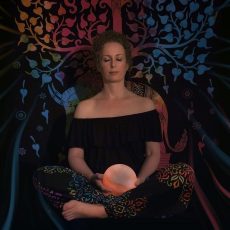
Over the years I have dealt with “Christian yoga” in several of my columns.  So I’ll briefly touch on it here for the simple reason that a large number of Christ followers have wholeheartedly embraced the Buddhist practice of yoga.  Even churches offer yoga classes with a Christian spin on it!  Not surprisingly, enterprising Christians head up successful yoga businesses such as “Holy Yoga,” “PraiseMoves and “Yahweh Yoga” (YY) just to name a few.  YY’s website promises to “increase the kingdom of Jesus Christ by establishing, providing and maintaining a Christian yoga studio and teaching academy that honors God in all business and ministry endeavors. Yahweh Yoga seeks to…empower men and women to de-stress, to grow in their relationship with Jesus Christ and to improve their mind, body and spirit…” 

It’s not a stretch to say that the language used to promote YY comes right out of the New Age handbook.

Here’s the bottom line.  So-called Christian yoga has nothing in common with authentic Christianity.   In fact, the Bible warns:

For ye were sometimes darkness, but now are ye light in the Lord: walk as children of light: (For the fruit of the Spirit is in all goodness and righteousness and truth;) Proving what is acceptable unto the Lord.  And have no fellowship with the unfruitful works of darkness, but rather reprove them. (Eph 5:8-11)

In one of my columns entitled Can A Pagan Practice Be “Christianized” I drew attention to the fact that,

Yoga is being marketed to mainline churches with the assurance of creating stress reduction, developing self-confidence, and improving concentration. It is also marketed to business and industry, athletes, senior citizens, students, teens and adolescents. Because of our fast paced life-style, who wouldn’t want to reduce stress? This is why yoga classes have become so popular. 

Now here’s the main reason Christians should avoid yoga. Christian apologists John Ankerberg and John Weldon maintain that, “The basic premise of yoga theory is the fundamental unity of all existence: God, man, and all of creation are ultimately one divine reality.” To explain the basic premise, the authors quote from an editorial in the Yoga Journal:

We are all aware that yoga means ‘union’ and that the practice of yoga unites body, breath, and mind, lower and higher energy centers and, ultimately self and God, or higher Self. But more broadly, yoga directs our attention to the unity or oneness that underlies our fragmented experiences and equally fragmented world. Family, friends, the Druze guerrilla in Lebanon, the great whale migrating north — all share the same essential [divine] nature.

This quote alone should raise concerns among Christians but when looked at in light of Bible expositor John MacArthur’s comments extracted from a CNN Primetime interview where he was asked “Should Christians practice yoga,” it ought to be completely clear that Christians should not participate: 

John MacArthur…wondered why Christians would want to “borrow a term that is part of a false religion” (that clashes with historic orthodox Christianity). MacArthur contends that Christians shouldn’t put themselves in weird physical positions, empty their minds, focus on him or herself, and try to find the “god within” as a way to relieve stress. “This is practicing a false religion,” he said rather pointedly. Then he boldly shared the gospel. He said in order to have a whole and complete life, Christians must go to the Word of God, to the Gospel of Jesus Christ, “The idea of Christianity is to fill your mind with biblical truth and focus on the God which is above you.”

We can be thankful that there are a few Christian leaders in America who are willing to stand up for the truth.

In conclusion, “Christian mysticism” has emerged from false religious systems.  But instead of fleeing from magical mystical practices, scores of Christians have embraced them!  The brethren must be warned that Scripture strictly forbids uniting with pagans and apostates.  Moreover, those who profess Christ must be admonished not to participate in Contemplative Prayer or any sort of mantra meditation for the reason that spiritual harm can result from it.

Research:

New Age Movement

Contemplative Prayer

Christian Yoga?

Copyright by Marsha West, 2013.  All rights reserved.

 

Exploiting Tragedy to Attack Critics

David Cousar is concerned about the way in which popular Bible teacher and author Beth Moore has used the tragic death of Rick Warren’s son to attack Warren’s theological critics, or, as Moore calls them, “bullies in the body of Christ.” Cousar begins:

I had promised myself not to write anything critical of Rick Warren in the wake of his son’s tragic and untimely death. My heart goes out to him and his family during this incredibly sad time.

So, what could possibly prompt me to write anything about him in less than a week after his horrific personal tragedy? It was his weekly email newsletter that he sends out to Pastors.com members. In it was featured an article by Beth Moore titled “Beth Moore: Sadness and Madness”.

View article →

What Southern Baptists Can Expect From Russell Moore and the ERLC

In this piece, Southern Baptist pastor Randy White lays out what he believes Southern Baptists can expect from the recent appointment of Dr. Russell D. Moore, who will replace the controversial Richard Land as the President of Ethics and Religious Liberties Commission of the Southern Baptist Convention. “Whether or not you are Southern Baptists,” says White, “Moore will have huge influence on the Christian worldview and expression of Christianity for many years to come. It is not hard to discern where Moore will lead, what he will emphasize, and what his values are, and this Southern Baptist is concerned.” View article →

The True Meaning of the Day in which Chocolate Was Invented

In our increasingly secular nation, a growing number of Americans are clueless as to the real reason for the Easter holiday. Case in point: This year’s White House Easter Egg Roll has as its theme “Be Healthy, Be Active, Be You!” In the United Kingdom somewhere around 80 per cent of children do not even know the true meaning of Easter. In this piece Marsha West reveals the far-left’s plot to secularize the Christian faith and then she lays out the true meaning of Easter. View article →

What Does a First Jesuit Pope Mean for Biblical Christians?

David Wheaton’s guest on The Christian Worldview is Phil Johnson, executive director of Grace to You. They discuss the significance of the new pope and what it means for the world and for biblical Christians. Wheaton poses the following questions: Is there any special significance to a first Jesuit pope? And what does it portend that evangelical leaders such as Rick Warren proclaim, “Join me today in fasting and prayer for the 115 Cardinals seeking God’s Will in a new leader” and Luis Palau declare that the new pope is “really centered on Jesus and the Gospel, the pure Gospel”? View article →

Retailers and Entertainment Industry Aspire to Hyper-sexualize Girls

Marsha West once again tackles our corrupt society’s hyper-sexualization of young girls. In this piece she exposes how lingerie company Victoria’s Secret is targeting middle school and high school girls with their new line of intimate undergarments. Marsha also confronts the popular teen girl magazine, Seventeen, for promoting Disney star Ashley Benson’s movie, “Spring Breakers,” on the magazine’s cover. The film is rated ‘R’ for strong sexual content, language, nudity, drug use and violence and contains graphic sex scenes between two women and a man, yet is being promoted to the young readers of this periodical. View article →

Charles Stanley Advises Christians to ‘Simply Listen for God’s Voice’

In two articles appearing this week [March 2013] in the Christian Post (CP), Charles Stanley, pastor of First Baptist Church Atlanta, discusses the mystic concept of waiting in silence and listening for the voice of God, seemingly independent of hearing God speak through His written Word.

In a 5 March 2013 article entitled, “Listening to God,” Stanley discusses prayer by appealing to the Old Testament figure of David. Stanley offers that David approached prayer by reviewing the past, reflecting upon the Lord’s character, recalling God’s promises and finally by making requests of God. This article curiously concludes, however, with Charles Stanley stating the following:

Stop for a minute and think about how you typically interact with God. If prayer time is dominated by your own talking, some adjustments may be in order. Just as the Lord spoke to David, God also has many things to say to you, if you’ll simply let Him speak. Source

Stanley’s language here seems vague, though his instruction appears to allude to the idea of listening for outside guidance from the Almighty, whether via an audible voice or impression or some other subjective means. This mirrors the practice of Eastern meditation and is mystical in its origins and unbiblical in nature.

A complementary article written by Stanley and appearing at CP on 6 March 2013 is entitled, “Meditation: The Key to Listening.” In this short piece, Stanley further reveals his true beliefs regarding this topic. He writes:

In our normal everyday lives, we are surrounded by countless voices in need of our attention. Our children cry for it, our employers demand it, and our loved ones yearn for it. With all of these bidding for our attention, no wonder God’s voice at times seems so muffled or distant.

Effective meditation requires seclusion. Unless we make an effort to escape our daily demands for at least a few moments, our ability to hear God’s voice will be weakened.

Source

To be sure, the Christian should pursue a time and place free of distractions to commune with God through the study of Scripture and through prayer. Silence should not be sought, however, in order that one may audibly hear from God. Yet, such a practice seems to be precisely what Charles Stanley is advocating as he concludes:

At some point today, turn off the TV, cell phone, and computer, and simply listen for God’s voice. Your schedule won’t surrender easily, so make a decision to claim a block of time for the Lord. Then quiet your extraneous thoughts, and focus on Him. Source

The words of Charles Stanley seem to prescribe a so-called Christianized form of contemplative prayer, one of the most esteemed spiritual disciplines taught in spiritual formation.

In both practice and purpose, contemplative prayer stands in contrast with what Scripture teaches about prayer. Practitioners believe that one must clear the mind of outside concerns so that God’s voice may more easily be heard. Advocates of contemplative prayer believe and teach that it is a necessary practice if one desires to become more like Christ. This latter point is especially interesting considering Charles Stanley’s appeal to Matthew 6:6 in his most recent article:

Our Lord was well aware of this need for isolation. In teaching about prayer, Jesus told the disciples to go into their rooms and close the door behind them. He knew it was vital to take a break from the pressures of life in order to truly commune with the Father. Source

In the passage to which Stanley alludes, the Lord is condemning the hypocritical, self-centered prayers of those who deliberately sought to be noticed by men while praying in public. When Jesus urges his followers to “go into your inner room, close your door and pray to your Father who is in secret” (Matt. 6:6, NASB), He is teaching His followers that the attitude of their heart in prayer should be to be heard by God, not men.

When Jesus was asked by His followers to teach them to pray, He instructed them in what is known as the Lord’s Prayer, as found in Matthew 6:9–13 and Luke 11:2–4. Noticeably absent from these passages is Jesus instructing believers to sit in silence and solitude listening for the audible voice of God or waiting for an impression that might be divinely sent.

When the Christian prays, he speaks to God. When the Christian desires to hear from God, he opens his Bible and reads. True, biblical prayer is talking to God the Father (Phil. 4:6) through Jesus Christ the Son (John 16:23) in the power of the Holy Spirit, understanding that what God has revealed in His Word is sufficient and that new revelation is unnecessary (2 Tim. 3:16–17).

The ground being tread by Charles Stanley is perilous, as those who seek and desire mystical experiences open themselves up to potentially dangerous deception. This is not the first time that Stanley’s thoughts on the matter have been exposed, however. As previously reported, in a November 2012 interview with Mark Galli of Christianity Today (CT), Stanley is referred to as a “mystic Baptist,” and, when directly asked about his claims that God speaks to him, Stanley responded by saying,

For me, I get this strong sense of feeling that’s so clear, so direct to me. Like this week, something happened and I thought, Well, I could do thus and such, and God said, “Don’t do that.” I don’t hear a voice, but it’s so crystal sharp and clear to me, I know not to disobey that.

I think that comes from early in life as you learn to listen. You make mistakes; after a while, you realize as you obey him, it turns out right, and whatever your reason was for not obeying him, it doesn’t turn out right.

Source

Stanley also stated in this CT interview that he wanted “the Holy Spirit to interpret the truth” for him. Surely this is the desire of every Christian. How, then, can one know that he is being guided by the Holy Spirit into the truth of God? Should one rely upon subjective feelings and impressions, or upon the clear, unambiguous and objective Word of God? How can one know what is true? It seems prudent to turn to the words of the Lord on the matter:

Sanctify them in the truth; Your word is truth. (John 17:17, NASB)

To engage in mystic meditation as taught and encouraged by Charles Stanley in these articles is to wander down dangerous and deceptive paths outside the boundaries of God’s perfect and holy Word. One of the battle cries of the Reformation was that of sola scriptura, Scripture alone, and truly it is sufficient for the Christian’s needs (2 Tim. 3:16–17), especially as one seeks to know God and to grow in faith. Scripture itself, as inspired by the Holy Spirit and as penned by David, attests to its own sufficiency:

The law of the LORD is perfect, reviving the soul; the testimony of the LORD is sure, making wise the simple; the precepts of the LORD are right, rejoicing the heart; the commandment of the LORD is pure, enlightening the eyes; the fear of the LORD is clean, enduring forever; the rules of the LORD are true, and righteous altogether. Ps. 19:7–9, ESV

May the Christian be satisfied with the true and perfect Word of God as found in Scripture.

By Erin Benziger of Do Not Be Surprised

A Warped Worldview: Another Moral Effect of Pornography

Dr. Albert Mohler brings to light a study at the University of Texas that suggests that “regular exposure to diverse and graphic sex acts” may change a man’s moral worldview. According to the study “exposure to pornography may well influence views on the legalization of same-sex marriage. He suggested that viewing pornography leads men, in particular, to shift to more positive attitudes toward same-sex marriage. Regnerus cited the New Family Structures Survey and then reported that a majority of men who view pornographic material “every day or almost every day” agreed that same-sex marriage should be legal.” View article →

The History Channel’s Bible Miniseries Mishandling of God’s Word

And do not be conformed to this world, but be transformed by the renewing of your mind, so that you may prove what the will of God is, that which is good and acceptable and perfect. Rom. 12:2, NASB

Back on February 14th my wife and I went to see a movie at a local theater. It was Lincoln, which I have wanted to see for some time since I have been reading Doris Kearns Goodwin’s book Team of Rivals upon which the movie is partially based. The book is history written based upon actual letters and diaries and records written by the people Goodwin wrote about in her book, however, in the movie, artistic license was obviously taken in order to dramatize certain things. Certain facts were made up and others were left out or changed in order “to fit the movie story line” and tell the story that Steven Spielberg wanted to tell. We arrived at the theater early, and we had to sit through nearly 30 minutes of previews and specials before our movie actually started. One of those specials that was previewed was The History Channel’s upcoming miniseries, “The Bible.” View article →