Conversationalism: Shall we sin so that grace may abound?

You see this was me too, but no one seemed to be on to me
Acting like a church kid, while addicted to pornography
See on Sunday I’d go to church, but Saturday getting faded
Acting if I was simply created just to have sex and get wasted
See I spent my whole life building this facade of neatness
But now that I know Jesus, I boast in my weakness

(Jeff Bethke, in his video poem)

Now the law came in to increase the trespass, but where sin increased, grace abounded all the more, so that, as sin reigned in death, grace also might reign through righteousness leading to eternal life through Jesus Christ our Lord.

What shall we say then? Are we to continue in sin that grace may abound?

(Rom. 5:20-21; 6:1)

Christians ought to live godly lives. We are all sinners saved by grace alone. Yet, what is the nature of our testimony? What are we to make of Jeff Bethke’s idea of “boast[ing] in … weakness”?

[more]

Why homosexuality IS different

For years, those of us doing ministry in the area of unwanted same-sex attraction and outreach to the gay community have worked diligently to help the church see that homosexual behavior is no different than any sin.

For those of us who struggled with same-sex attraction, the church’s seeming placement of homosexuality at the top of some created “sin hierarchy” was frustrating and hurtful to us. And we worried that as long as the church treated homosexual behavior as the worst of all sins, people would continue to fear the church instead of finding hope in the church. Read more

Who Is This Who Even Forgives Sins?

by Mike Ratliff

48 εἶπεν δὲ αὐτῇ· ἀφέωνταί σου αἱ ἁμαρτίαι. 49 καὶ ἤρξαντο οἱ συνανακείμενοι λέγειν ἐν ἑαυτοῖς· τίς οὗτός ἐστιν ὃς καὶ ἁμαρτίας ἀφίησιν; (Luke 7:48-49 NA27)

48 And he said to her, “Your sins have been forgiven.” 49 And the ones reclining with him began saying among themselves, “Who is this who even forgives sins?” (Luke 7:48-49 Possessing the Treasure New Testament V1)

In Luke 7:36-50 there are three main characters. There is our Lord Jesus Christ, Simon the Pharisee, and an unnamed woman who is referred to in v37 and v39 simply as ἁμαρτωλός (hamartōlos), “sinful, sinner.” The events in this passage take place at a meal in Simon’s home and there are others reclining at the table with them. The unnamed woman is uninvited. These events take place in Galilee immediately after John the Baptist’s disciples have come to our Lord on his bequest to confirm whether Jesus is indeed the Messiah. He then shows the Pharisee’s hypocrisy in vv31-35 for rejecting John the Baptist even though he lived in rigid abstinence even though they demanded that of our Lord while the message preached by both was the same. Then in v36 one of these Pharisees, Simon, invites Jesus to eat with him.

(click here to read this post)

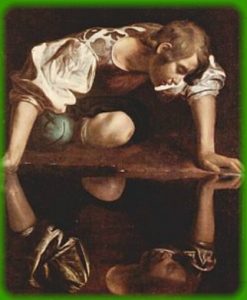
Narcigesis

NARCIGESIS [nahr- si -jee’ -sis]

[(From: narcissus; 1540–50; < Latin < Greek nárkissos plant name, traditionally connected, by virtue of plant’s narcotic effects, with nárkç numbness, torpor; probably from a pre-Gk. Aegean word, but associated with Gk. narke “numbness” (see narcotic) because of the plant’s sedative effect.) (From: eisegesis; 1890–95; < Greek eisḗgesis, equivalent to eis- into + ( h ) çge- (stem of hçgeîsthai to lead) + -sis -sis {C19: from Greek eis into, in + -egesis, as in exegesis}.)]

ORIGINS:

Classical Mythology: a mythological youth (Narcissus) who fell in love with his own image reflected in a pool and wasted away from unsatisfied desire, whereupon he was transformed a plant bearing his name, commonly associated with an amaryllidaceous plant of the Eurasian genus Narcissus, esp N. poeticus, whose yellow, orange, or white flowers have a crown surrounded by spreading segments.

Classical Psychology: “Narcissists” are people completely absorbed in themselves. (See narcissism.) Inordinate fascination with oneself; excessive self-love; vanity.

noun

  1. The reading of one’s own life experiences and/or that of another’s life experience, into the text of Scripture; the need to make the Bible all about themselves.
  2. An interpretation of Scripture based on the interpreter’s self-authority, particularly driven by self-esteem, self-actualization, mystical experiences and/or the interpreter’s “felt needs.” (See Sola Experientia)
  3. A personal and/or mystical interpretation of Scripture based on the interpreter’s own ideas, biases, opinions, feelings, attitudes, beliefs, experiences, impressions, dreams, revelations, or the like, rather than based upon the plain meaning of the text.
  4. The reading of one’s own doctrinal theories into Scripture (as opposed to exegesis, which is a critical explanation or interpretation of a text or portion of biblical text), particularly as a result of personal experience. (See Sola Experientia)
  5. Self-centered, self-defined and self-authenticating biblical interpretation, application and counsel.
  6. The reading of one’s own interpretation into Scripture based upon the egotistic belief that all things in Scripture are not alike plain in themselves, nor alike clear unto all; and that only the learned, the elect, or the leadership elite (of which the interpreter considers himself), may attain unto a sufficient understanding of them. (See Plura Scriptura)
  7. The egotistical drive to invent new theologies, doctrines, revelations, applications and philosophies about Scripture, often manifested in self-aggrandizement activities such as book publishing, conferences, setting up organizations and websites, money-making schemes and publicity drives.
  8. Oxymoron: Subjective exegesis.

adjective: narcigetic, narcigetical

See PLURA SCRIPTURA and SOLA EXPERIENTIA

*Adapted from http://www.dictionary.com/

See also:

REFORMERGENT

DOMYSTIC

PROTHOLIC

Plura Scriptura

Roman Catholic contemplative mysticism slithers throughout the mainstream of the church visible and as charismatics embrace it we’re awash with people claiming God is speaking to them outside of Scripture.

Apprising Ministries now brings you a key tenet of this reversal of the Protestant Reformation with this definition here.

Access not Impetuosity

by Mike Ratliff

7 οὗ ἐγενήθην διάκονος κατὰ τὴν δωρεὰν τῆς χάριτος τοῦ θεοῦ τῆς δοθείσης μοι κατὰ τὴν ἐνέργειαν τῆς δυνάμεως αὐτοῦ. 8 Ἐμοὶ τῷ ἐλαχιστοτέρῳ πάντων ἁγίων ἐδόθη ἡ χάρις αὕτη, τοῖς ἔθνεσιν εὐαγγελίσασθαι τὸ ἀνεξιχνίαστον πλοῦτος τοῦ Χριστοῦ 9 καὶ φωτίσαι [πάντας] τίς ἡ οἰκονομία τοῦ μυστηρίου τοῦ ἀποκεκρυμμένου ἀπὸ τῶν αἰώνων ἐν τῷ θεῷ τῷ τὰ πάντα κτίσαντι, 10 ἵνα γνωρισθῇ νῦν ταῖς ἀρχαῖς καὶ ταῖς ἐξουσίαις ἐν τοῖς ἐπουρανίοις διὰ τῆς ἐκκλησίας ἡ πολυποίκιλος σοφία τοῦ θεοῦ, 11 κατὰ πρόθεσιν τῶν αἰώνων ἣν ἐποίησεν ἐν τῷ Χριστῷ Ἰησοῦ τῷ κυρίῳ ἡμῶν, 12 ἐν ᾧ ἔχομεν τὴν παρρησίαν καὶ προσαγωγὴν ἐν πεποιθήσει διὰ τῆς πίστεως αὐτοῦ. 13 διὸ αἰτοῦμαι μὴ ἐγκακεῖν ἐν ταῖς θλίψεσίν μου ὑπὲρ ὑμῶν, ἥτις ἐστὶν δόξα ὑμῶν. (Ephesians 3:7-13 NA27)

7 Of which I became a minister according to the gift of the grace of God having been given to me according to the working of his power. 8 To me, the least of all the saints, this grace was given to the gentiles to preach the unsearchable wealth of Christ 9 and to enlighten all men as to what is the stewardship of the mystery hidden from the ages in God, the one who created all things 10 that it might be made known now to the rulers and the authorities in the heavenlies through the Church the many faceted wisdom of God 11 according to the plan of the ages, which he made in Christ Jesus our Lord 12 in whom we have boldness and access in confidence through faith in him. 13 Therefore, I ask you not to despair concerning my afflictions for you, which is for your glory. (Ephesians 3:7-13 Possessing the Treasure New Testament V1)

In our last post, Boldness not Insolence, we saw from Ephesians 3:7-13 (above) that those truly in Christ have indeed been given the incredible privilege of unimpeded access to the Throne of Grace, and that means they can come “boldly” to their Heavenly Father in Christ-confidence, not self-confidence. From this same passage we also see the “access” all in Christ have as a granted privilege. This access to come boldly to God in prayer has been granted only to those in Christ, no one else. Even so, this privilege is not to be taken for granted by Christians being impetuous or impulsive, that is, doing things hurriedly, or rushing about. I often despair of my lack of time in prayer each day as I take small parts here and there and pray hurriedly through them. What good is that? When we do that, our prayers become habitual and rushed and nothing more than a form of idolatry.

(click here to read this post)